The story of Private Wally Johnson
In the thick jungles of New Guinea during World War II, Australian soldiers faced relentless terrain, disease, and enemy fire. Among them was Private William Oswald Wallace Johnson. A young man from Moe, Victoria, whose bravery and endurance would come to symbolize the spirit of the Australian digger.
A Soldier from Moe
Born and raised in the Latrobe Valley, Wally Johnson enlisted in the Australian Army during the height of the Second World War. Assigned to the 58th/59th Battalion, he was sent to New Guinea, one of the most punishing theatres of the Pacific campaign. The battle for the strategic town of Salamaua was fierce, with soldiers often engaging the enemy in dense jungle and pouring tropical rain.
The Battle of the ‘Coconuts’
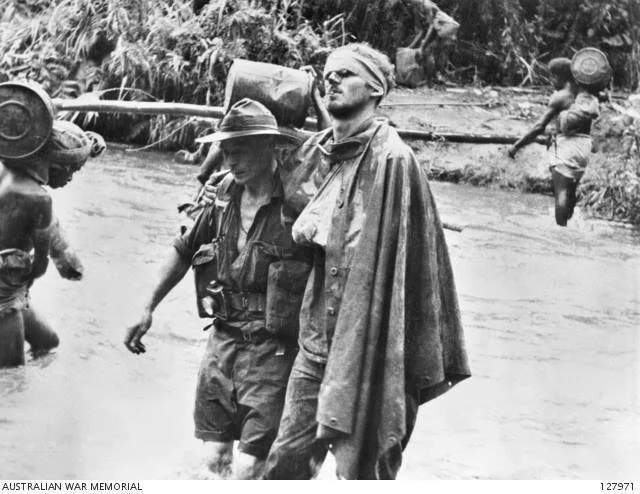
On July 13, 1943, during an intense assault on a fortified Japanese position known as the “Coconuts,” Wally was gravely wounded by a grenade. Despite his injuries, he stayed composed and alert, holding on as his mates moved him to safety under fire. In a moment that has become etched into Australian military history, Sergeant Gordon Ayre carried the wounded Wally across the swollen Francisco Creek to an advanced aid post.
That moment was captured by legendary war photographer Damien Parer. The black-and-white image, showing Ayre helping a drenched and bloodied Wally through a jungle stream, became one of the most iconic images of Australian bravery and mateship from the war.
Honoured at Home
In Moe, Wally’s legacy is remembered with deep respect. A bronze statue now stands in the foyer of the Moe RSL, immortalizing the moment captured in Parer’s photo. In 2024, a striking mural was unveiled at the same venue, paying tribute to Wally and all those who served in the 58th/59th Battalion. These memorials serve not just as a tribute to one man’s bravery, but as a reminder of the sacrifices made by an entire generation.